
Storm Damage? Call Us for Fence Repair at Your Seattle Property
A windstorm knocked your fence over or a tree landed on it. Here is what to do before the crew arrives, what to photograph, and how we decide between repair and rebuild.
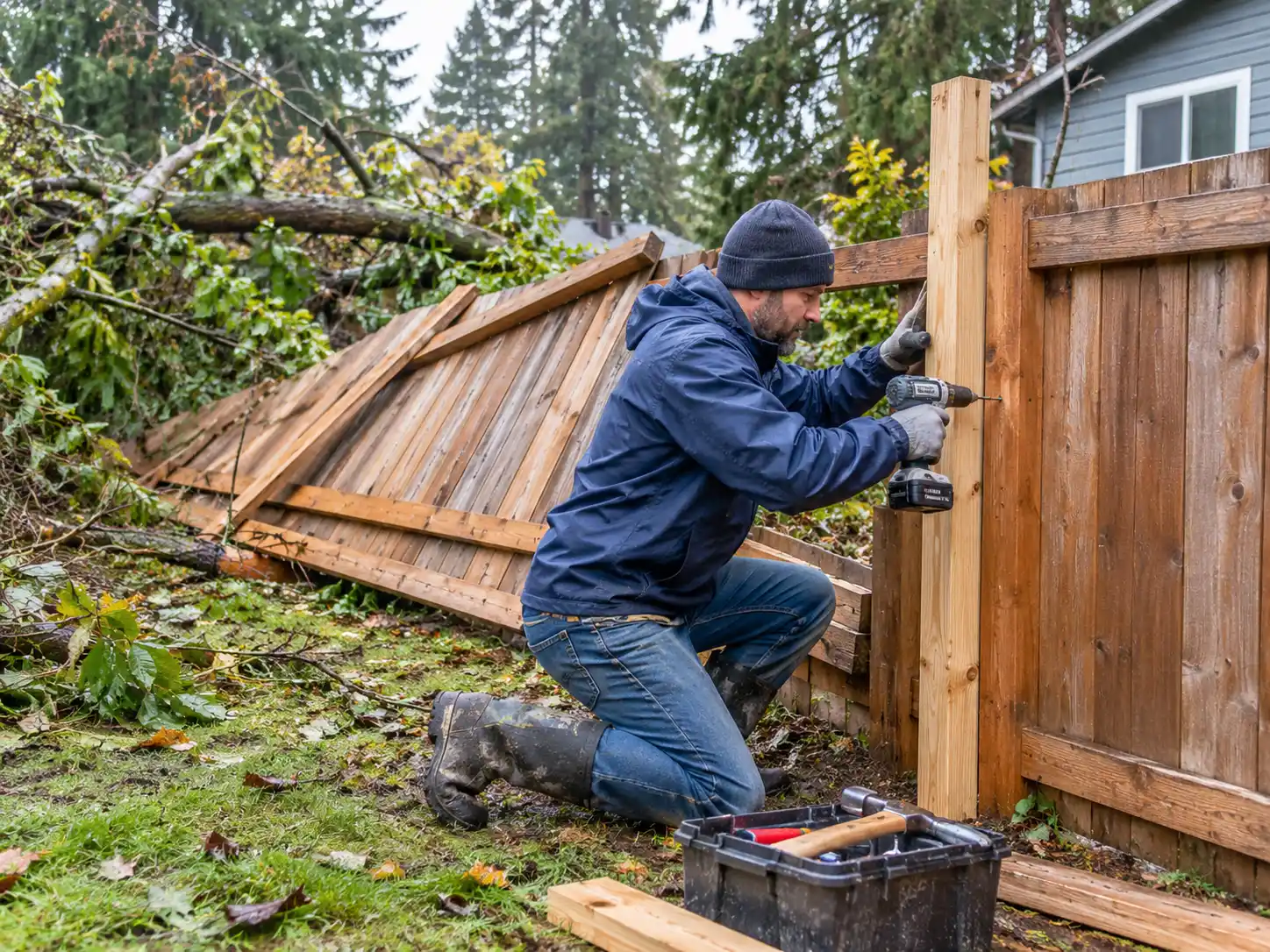
When a Puget Sound windstorm pushes a fence over, the first job is not the fence. It is making sure nobody gets hurt, the dog stays in, and the damage is recorded before anything gets moved. After that, most storm damage falls into a few predictable patterns, and each one has a clear fix that our fence repair crews handle every winter.
Before you touch anything: safety and the yard
Look up first. A tree that took out a fence section may have left hanging limbs, and a leaning trunk can keep moving as the soil softens. If a power or cable line is down or touching the fence, stay away and call the utility, because a wet wire fence or a metal gate can carry current.
Next, look at what the fence was keeping in or out. A gap on the side facing the street or a neighbor's yard is a problem tonight, not next week. A sheet of plywood screwed to two standing posts, a length of temporary construction fencing, or a run of rope tied post to post for a calm dog will hold until the repair. Do not try to stand a heavy panel back up on a snapped post; it will fall again in the next gust and it may fall on someone.
Photos that make the insurance claim and the estimate easier
Take pictures before you clear anything. A wide shot of the whole run shows how far the damage goes. Close shots of the base of each broken post show whether it snapped above the ground, pulled out with its footing, or rotted through. If a tree caused it, photograph where the trunk came from and the stump or root plate.
Many homeowner policies treat a fence as a separate structure from the house, with its own limit and deductible. Your agent can tell you how yours reads. The photos also help us, because a broken post that was already soft at the soil line points to a different repair than a sound post that simply took too much load.
Three kinds of damage we see after every big blow
The first is the leaner. Posts are intact, but saturated soil let several footings tip, and the fence now sits at an angle. If the wood is sound, we dig out, re-plumb and re-set those posts, often on new footings that drain better.
The second is the snapped line. Posts broke at or just below grade, usually because decay had already eaten the core. Wind found the weak points. Those posts get replaced, and we check the rest of the run with a probe, because a fence with three rotten posts usually has more.
The third is impact damage from a tree or a large limb. Rails crushed, pickets split, sometimes a gate frame twisted. The posts on either side may be fine. We rebuild the crushed bays and rehang or rebuild the gate. When the tree came from next door, the question of who pays is separate from the repair itself; our page on Washington boundary fence laws explains how shared and neighboring fences are usually handled.
When a storm repair turns into a rebuild
A storm is often the day an old fence admits it is old. If more than a third of the posts are soft, if rails are rotting where they meet the posts, or if the panels are held up only by their neighbors, patching the fallen section buys a short time before the next wind finds the next weak spot. Our comparison of repair versus replacement lays out the signs. We will tell you which side of that line your fence is on after we walk it.
If we built the fence, read the terms of our workmanship warranty before you call; it spells out what is covered after weather and falling trees and what is not.
Building it back so the next storm does less
A repaired fence should come back stronger than it went down. That can mean deeper or wider footings in soft ground, steel posts behind a cedar face on the windward side, or a gap between boards on a tall solid run so the panel stops acting like a sail. The details of setting posts in local clay are covered in our explainer on concrete, gravel and steel footings.
Send us the photos you took and the address, and we will tell you what the repair looks like and how soon a crew can secure the gap.
FAQ
Is a fence knocked down by wind usually covered by homeowners insurance?
Often it is, under the part of the policy that covers detached structures, though deductibles and limits vary. Fences that fell because of long-term rot or neglect are commonly excluded. Your agent is the right person to confirm how your policy reads.
Should I stand the fallen panels back up myself?
Only if the posts are sound and the panel can be braced safely. Leaning a panel on a broken post just sets up the next collapse. A temporary barrier is safer until the posts are repaired.
Who pays when the neighbor's tree falls on my fence?
That depends on the tree's condition and on what both properties' insurers decide. Start with photos and a conversation with your neighbor and your agent. The repair can usually go ahead while the cost question is settled.
Can you fix just the section that fell?
Yes, when the rest of the fence is sound. We check the remaining posts before quoting so the estimate covers what is actually failing, not only what is lying on the ground.
How can I make a tall fence handle wind better?
Stronger footings, steel posts on exposed runs, and board spacing that lets some air through all help. On a very exposed line we may suggest a lower solid section with an open top.
More From the Blog
 DIY & How-To
How to Install a Wood Privacy Fence: The Build, Step by Step
Layout, post holes, concrete, rails, boards and gate for a 6-foot cedar privacy fence, with the details that matter in the wet Seattle climate.
 DIY & How-To
How to Align Fence Panels: Straight Lines, Even Heights, Clean Slopes
Straight fence panels start with the posts: string lines, exact spacing, cutting to height, stepping or racking on slopes, and fixing a crooked panel.
 DIY & How-To
Tools for Installing Fence Posts: The Complete Checklist
Every tool for setting fence posts, from string line and post-hole digger to digging bar, auger and post level, with what to rent and what to buy.
Planning a fence?
Price it in a minute with the calculator, or send a few photos for a free written estimate.