
Bellevue's fence rules for corner lots and sight distance
A Bellevue corner lot fence faces two street frontages and a clear-vision triangle at the corner; here is what the city checks and how to keep privacy.
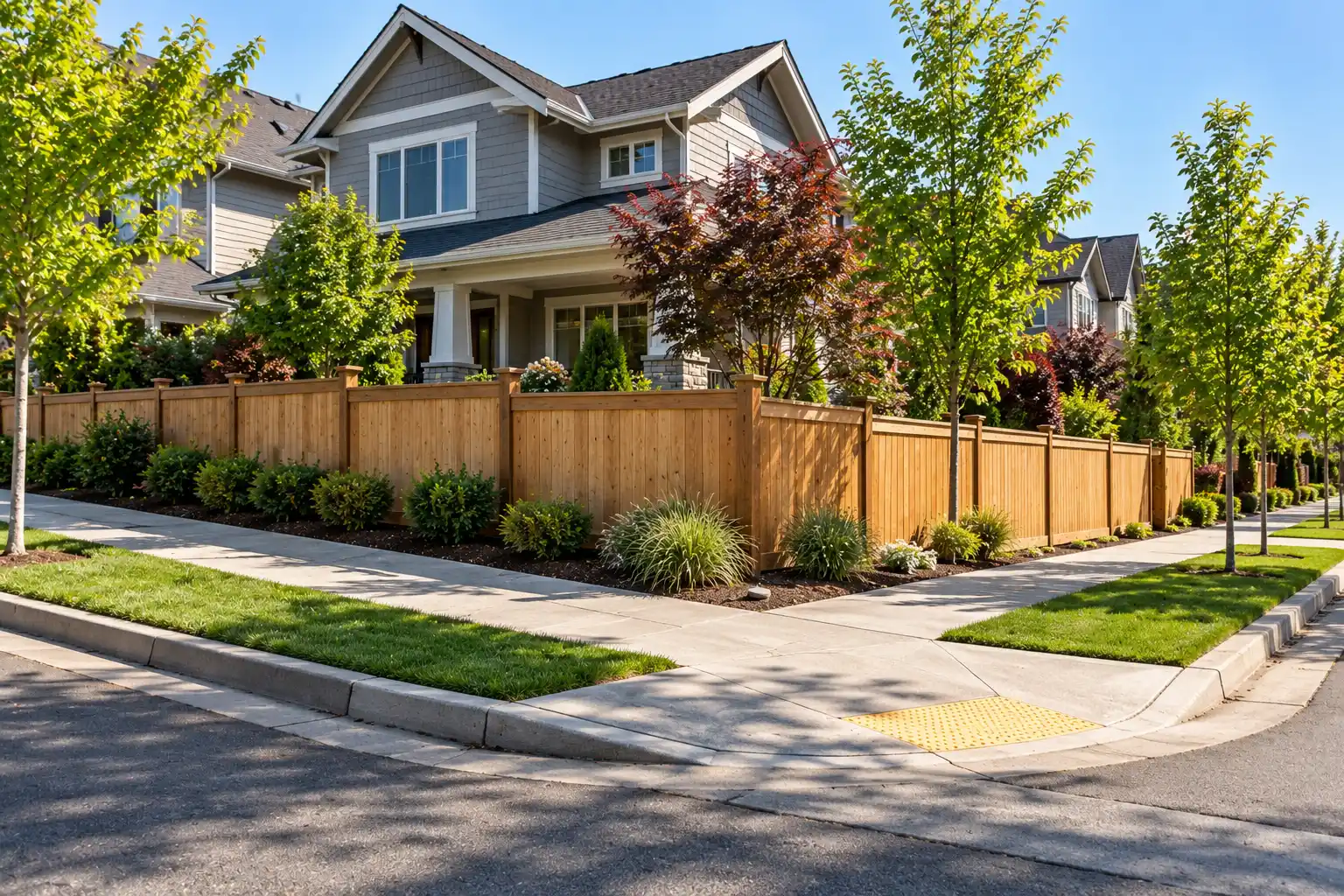
A Bellevue corner lot fence is governed by two sets of limits at once. Both street frontages are treated as front yards with the lower front-yard height, and the corner where the streets meet holds a clear-vision area that no solid fence, wall or hedge may block. Privacy on a corner lot comes from where the fence stands, not from building it taller.
The clear-vision area is the triangle at an intersection or driveway, measured along both edges of pavement, that must stay open so drivers can see cross traffic. What this means for you:
1. The fence along each street gets the front-yard limit, not the side-yard limit; the figures are on our Bellevue fence rules page.
2. Nothing solid can stand inside the triangle at the street corner, whatever height it is.
3. Where your driveway meets the sidewalk, a second, smaller triangle applies on both sides.
| Part of the corner lot | Rule that applies | Typical fix |
|---|---|---|
| Frontage on the main street | Front-yard height limit | Low fence or open-style panels at the street line |
| Frontage on the side street | Front-yard limit again, because the lot has two fronts | Pull the taller privacy fence back to the setback line |
| The street corner itself | Clear-vision triangle, no solid screening | Clip the corner panel or leave it open |
| Driveway edges | Driveway sight triangle on both sides | Step the fence down or open it near the apron |
| Interior side and rear lines | Standard side and rear limits | Full-height privacy fence allowed |
Why a corner lot has two front yards in Bellevue's code
Bellevue's zoning code defines a front yard by its relationship to a street, not by where the front door faces. A lot bordered by two streets therefore has two front yards, and each gets the front-yard fence limit along its full length.
For a homeowner that means the yard you think of as the side of the house counts as a front yard whenever it faces pavement. The fence you planned for that side is held to the lower limit all the way to the rear property line, unless it is pulled back behind the required front-yard setback.
The setback line is the key. Inside the setback the lower limit applies; behind it the taller limit returns. The measurements for each zone are on our rules page, and the city publishes the underlying code at bellevuewa.gov. The same two-front logic shows up in other cities we serve across the Eastside, with different figures in each.
Seattle handles its corner lots on the same two-front principle but with different figures and a different permit path. We compared that side of the lake in our post on Seattle's front-yard fence code.
The clear-vision area: the triangle you cannot block
The clear-vision area is a triangle drawn from the point where two street edges meet, with its two legs running a set distance along each street and its third side closing the shape across your lot. Within that triangle the city limits anything that blocks a driver's view, including fences, walls, hedges and parked trailers.
The rule protects the driver stopped at the intersection who needs to see traffic coming from the left and right. A solid fence at the corner, even a low one, hides a child on a bicycle or a car rolling through.
The triangle sits partly on public right-of-way and partly on private land. That is why a fence built exactly on your property corner can still violate the rule. The legs are measured from the curb or pavement edge, not from your property pin, so the triangle reaches inward onto the lot.
Open fences are treated differently from solid ones inside the triangle. An ornamental metal fence with widely spaced pickets lets a driver see through it, so the code tolerates it where a board fence would be refused. Our ornamental iron fence page shows the styles that qualify as open.
Driveway sight lines count too
A driveway is treated as a small intersection with the sidewalk and the street, so a sight triangle applies on each side of it. The triangle is smaller than the one at the street corner, but it still keeps a solid fence away from the apron.
The reason is the same. A driver backing out needs to see pedestrians on the sidewalk, and a pedestrian needs to see the car. A privacy fence that runs right up to the driveway edge creates a blind exit.
Ways to get privacy on a corner lot without violating the triangle
Privacy on a corner lot is a matter of placement. These are the options we use, roughly in order of how much screening each gives up.
1. Pull the fence back behind the front-yard setback line on the side street, so the full-height privacy fence starts where the taller limit begins.
2. Lower only the corner panel, keeping the rest of the run at full privacy height and dropping the bay that falls inside the triangle.
3. Switch the corner bay to an open-style panel, such as spaced pickets or ornamental metal, so the triangle stays see-through while the fence line stays continuous.
4. Plant a low hedge inside the fence line, behind the triangle, and let the fence at the street stay open.
What we check at a Bellevue corner before we quote
Our checklist for any Bellevue corner is the same every time. We confirm which two frontages count as front yards, locate the setback line on the side street, draw the clear-vision triangle from the pavement edges rather than the property pins, and mark the driveway triangles. Only then do we lay out a fence that stays full height where the code allows it and opens up where it does not.
Walk us around your corner and we will stake the triangles before you decide on a style, starting with our Bellevue fence contractor page.
FAQ
Does the clear-vision rule apply to open ornamental fences?
Mostly no. The rule targets anything that obstructs a driver's view, and a fence with wide picket spacing is treated as see-through. The city still looks at the picket pattern, so a dense ornamental panel with decorative infill can be refused. Open spacing at the corner bay keeps the fence compliant.
Can a fence sit in the triangle if it is below a certain height?
Yes. Bellevue allows a low fence inside the clear-vision area as long as it stays under the sight-line height the code sets, because a driver sees over it. The threshold is on our Bellevue fence rules page, and anything above it must stay out of the triangle.
Do alleys count as streets for the triangle?
Where an alley meets a street, a smaller sight triangle applies, similar to a driveway. An alley does not create a second front yard the way a side street does, so the fence along an alley keeps the standard side or rear limit outside that small triangle.
Will the city inspect a corner fence?
Bellevue does not send an inspector for a fence that needs no permit, but code enforcement responds to complaints, and corner sight-line complaints are common. A fence that blocks the triangle can be ordered cut down or moved after it is built, which is why we stake the triangle first.
What if the neighbor's hedge already blocks the view?
A neighbor's violation does not change what your fence is allowed to do. The city can require the hedge be trimmed if it is reported, but your fence is judged on its own position. Build to the triangle on your side, and treat the hedge as the neighbor's problem to solve.
More From the Blog
 DIY & How-To
How to Install a Wood Privacy Fence: The Build, Step by Step
Layout, post holes, concrete, rails, boards and gate for a 6-foot cedar privacy fence, with the details that matter in the wet Seattle climate.
 DIY & How-To
How to Align Fence Panels: Straight Lines, Even Heights, Clean Slopes
Straight fence panels start with the posts: string lines, exact spacing, cutting to height, stepping or racking on slopes, and fixing a crooked panel.
 DIY & How-To
Tools for Installing Fence Posts: The Complete Checklist
Every tool for setting fence posts, from string line and post-hole digger to digging bar, auger and post level, with what to rent and what to buy.
Planning a fence?
Price it in a minute with the calculator, or send a few photos for a free written estimate.